
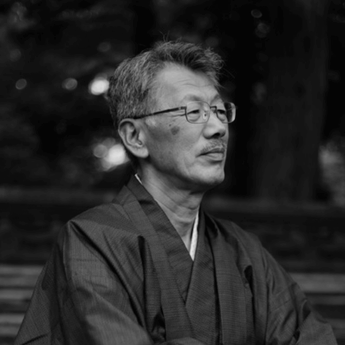
加藤 尊也 / Kato Takaya

A legendary craft
made for only thirty years

Mogusa clay, the raw material
of Seto-guro and Shino,
is a rare clay that is hard to obtain—
destined one day to become a legend
Over tens of thousands of years, volcanic activity and rain transform the character of the soil. The natural terrain, enclosed by mountains, created a special clay unique to this area. The clay deposited here—commonly known as Mogusa clay—contains a small amount of iron and can withstand rapid cooling. This is what gives Seto-guro its deep, absorbing jet black, and brings out the beautiful fire color that is the hallmark of Shino. Mogusa clay is coarse and holds many fine air pockets, so even after firing, a vessel feels warm and soft in the hand.

It entrusts itself to nature, embraces impermanence, and reveres it.

Kōun Ryūsui — Drifting Clouds, Flowing Water
and gives them form while sketching.
Each sketch is a single, decisive stroke.
Details of form and color are considered carefully over about seven days, and there is no correcting at the end.
The overall image is designed with a brush.
For some works, he has recreated the hand-turned wheel
that was actually used five hundred years ago, and uses it.
Unlike an electric wheel, its speed is not constant,
so it can express the gentle flow of time born of the clay's natural stretch.
Delighting in the gifts of nature that the changing seasons bring is the same now as it was long ago.
Mountains, the moon, the sea, the wind, rivers, the turning of the seasons.
So that you may feel these things when you use the vessel, and so that your heart may be enriched even a little,
he always keeps this in mind as he works.

A Century-Old Workshop

Known as a town of pottery, Tajimi is home to many kilns and carries on a history of tradition and innovation.
At Son, the hundred-year-old hand-turned wheel inherited from the previous generation has been restored and is still in use today.
Biography
- 1960
- Born in Tajimi, Gifu Prefecture
- 1984
-
Graduated from Musashino Art University
Selected for the Asahi Ceramic Art Exhibition (several times since)
Gifu Prefectural Art Exhibition, Prefectural Exhibition Prize
Selected for the Chunichi International Ceramic Art Exhibition
- 1985
- Selected for the Asahi Craft Exhibition (several times since)
- 1986
- Selected for the Yagi Kazuo Prize for Contemporary Ceramics (several times since)
Led the movement to preserve the Onada Amagane old kiln site
- 1987
- Selected for the Japan Ceramic Art Exhibition (several times since)
- 1989
- Selected for the Ceramic Art Biennale (several times since)
- 1991
- Mino Ceramic Art Exhibition, Encouragement Prize (several times since)
- 1993
- Selected for the Japan Traditional Kōgei Exhibition (several times since)
Selected for the International Ceramics Festival Mino (several times since)
- 1994
- Tokai Traditional Kōgei Exhibition (several times since)
- 1997
- Exhibited at the Tokai Ceramic Art Exhibition (Nagoya Congress Center)
- 1999
- Studied Seto-guro under Kato Kozo, Living National Treasure,
at his Fūjuku school
- 2002
- Certified as a full member of the Japan Kōgei Association
- 2004
- Exhibited at Mino Ceramics Now 2004
(Museum of Modern Ceramic Art, Gifu)
- 2005
- Studied Shino under Suzuki Osamu, Living National Treasure,
at a successor-training workshop
- 2012
- Commended by Gifu Prefecture for contributions to the continuation of traditional culture (Shino)
- 2018
- Mino Tea Bowl Exhibition, Bronze Prize
Selected for the Contemporary Tea Ceramics Exhibition (several times since)
- 2020
- Mino Tea Bowl Exhibition, Encouragement Prize
- 2022
- Received the 39th Takuo Prize
Currently
- Full Member, Japan Kōgei Association
- Executive Director, Mino Ceramic Art Association
- Certified Traditional Craftsman
Exhibitions & Awards
Asahi Ceramic Art Exhibition, selected 5 times
Chunichi International Ceramic Art Exhibition, selected
Japan Ceramic Art Exhibition, selected 2 times
Ceramic Art Biennale, selected 2 times
Mino Ceramic Art Exhibition, Encouragement Prize 3 times
Tokai Traditional Kōgei Exhibition, 10 times
Japan Traditional Kōgei Exhibition, 4 times
International Ceramics Festival Mino, selected 3 times


Message
Crafts are often referred to as "the beauty of utility."
While crafted for daily use, the refined vessels from Son are also considered art.
At Son, our Craft Art is based on the concept of "useful art," where the true value is revealed through use.
Son's vessels evoke different feelings for different people.
When you need to calm your mind or feel uneasy, please take a moment to enjoy a sip with a Son vessel.
We create each piece with the hope of enriching your heart, even just a little.
Access
Yamama Pottery
507-0018
3-27 Takada-cho, Tajimi-shi, Gifu
Gallery Son Nagano
Gallery Son
Business hours: 10:00-17:00 (Reservation required)
Postal code: 399-3705
364-1 Nanakubo, Iijimamachi, Kamiina-gun, Nagano
Email: info@gallery-son.com
[For those coming by car]
7 minutes walk from Nanakubo Station on the JR Iida Line
[For those coming by train]
15 minutes from Komagatake SA Smart IC, 11 minutes from Matsukawa IC