Article: The Beauty of a Clouded Moon: Wabi-Sabi, and a Single Tea Bowl
The Beauty of a Clouded Moon: Wabi-Sabi, and a Single Tea Bowl
Gallery Son Journal · on wabi-sabi, and the work of Kato Takaya
“Wabi-sabi” has become a word the whole world uses. It is almost always translated as “the beauty of imperfection” — and that translation misses nearly everything. The Muromachi-era tea master Murata Jukō is said to have held that a moon glimpsed through a break in the clouds moves the heart more than a moon in a cloudless sky. Not the perfect full moon, but the hidden one. The true meaning of wabi-sabi lives in feelings like this — and nowhere does it live more clearly than in a single tea bowl.
Wabi and sabi — two words
Wabi-sabi began as two distinct words. Wabi is simplicity, and a quiet contentment found within what is modest, or even lacking — the composure to feel no poverty in plainness, and no bitterness in falling short. That is wabi. Sabi is the beauty that time reveals — the depth carried by the aged, the used, the weathered, which the new does not have. The two fused, and became the spine of the tea aesthetic.
From Chinese perfection to the humble bowl
This feeling was born of a great shift. The tea of the Muromachi era prized the flawless imported wares of China — karamono — above all. Then Murata Jukō began a “wabi tea” that deliberately used simple, rough, even chipped Korean and Japanese bowls instead. He turned tea from a display of wealth into a practice of humility and of presence — of being here, now. Sen no Rikyū is said to have later perfected it: he set aside opulent utensils, stripped away every superfluous gesture and ornament, and chose humble Raku bowls; he is remembered for preferring a wildflower to a cultivated bloom.
Not imperfection itself — glimpsing the unseen
Here the most common misunderstanding should be cleared away. Wabi-sabi is not the idea that “a flaw is pretty.” It does not ask us to admire a crack or a warp for its own sake. Its essence is this: through that incompleteness, we catch a glimpse of something not openly shown. A clouded moon moves us more than a full one because the viewer’s own mind completes what is hidden. A bowl finished too perfectly says nothing. A bowl that is a little uneven lets the eye look into what lies beneath.

“I do not warp a bowl on purpose,” says Kato Takaya. “To manufacture a distortion makes it a lie. Only when I give myself to the clay and to the fire, and the unevenness arises on its own — only there does depth live. The viewer is looking into that depth.”
The wabi-sabi the fire draws
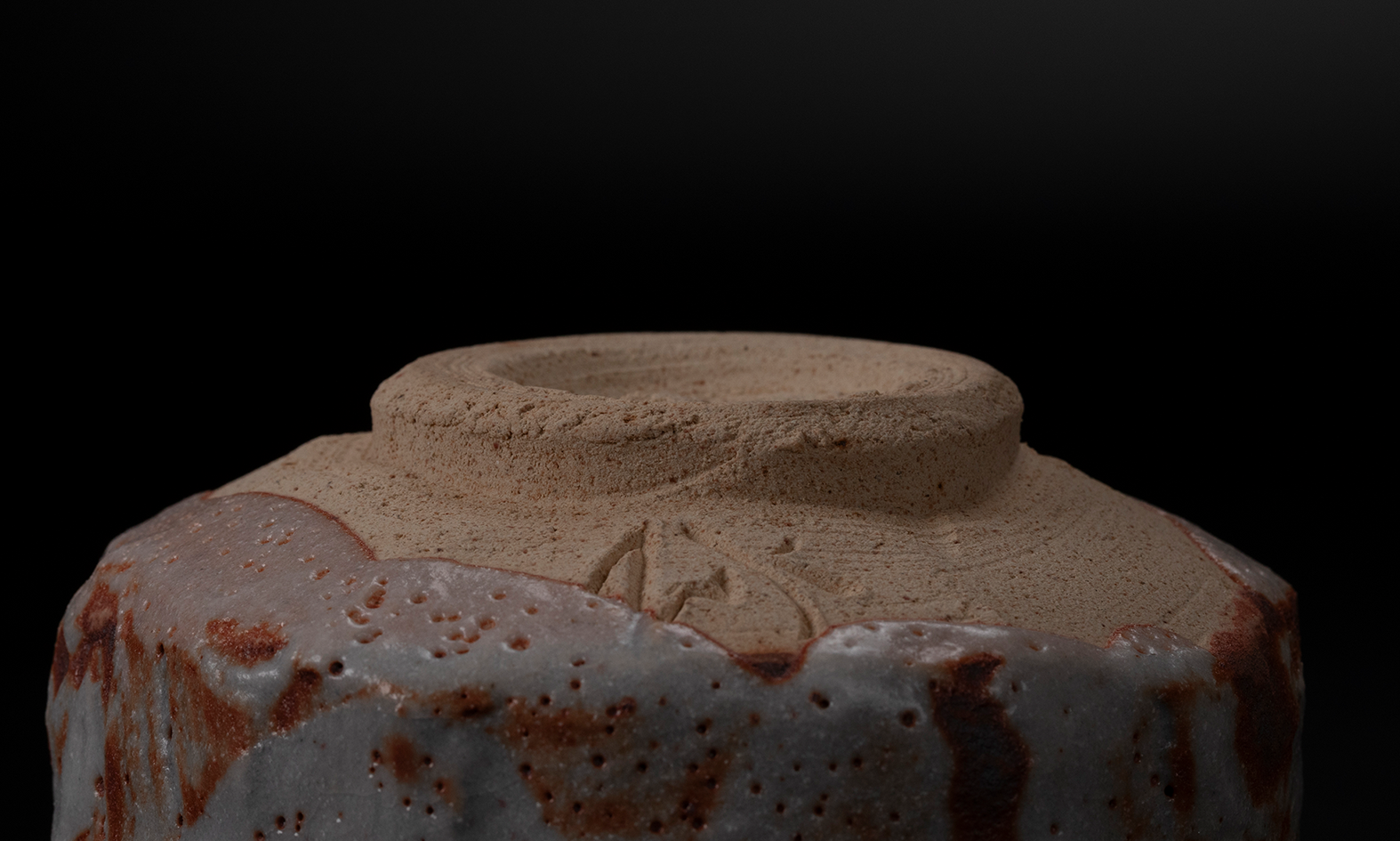
This is why Shino and Seto-guro carry wabi-sabi not as decoration but as fact. The fire color that rises faintly through Shino’s white was not painted; it was given by the flame. The black of Seto-guro is decided in the single moment it is drawn from the kiln. None is perfectly symmetrical; no two are alike. These are not flaws but proof that the bowl was born once, and only once. And sabi is yet to come: the bowl will be used, washed, and will age quietly in its owner’s hands for years.

“A tea bowl is completed only after it leaves my hands,” Kato says. “Used, and carried through time, it begins to show sabi. What I make is only the beginning. The rest is drawn by the one who holds it, and by the years.”
Not a style, but a way of seeing
Wabi-sabi is not an interior style, nor a fashionable word. It is a way of meeting the world: to find a deeper beauty within what is incomplete, what passes, what will one day be lost. To take a single tea bowl into your hands is to make that way of seeing your own, for a little while.

“It is not that the imperfect is beautiful,” Kato says in closing. “What is not perfect is beautiful because it is alive. A bowl, a person — I think they are the same in this.”
The Shino and Seto-guro of Kato Takaya can be seen at Gallery Son.