Warped on Purpose: Furuta Oribe and the Beauty of Breaking the Form
Gallery Son Journal · on Momoyama Mino, and the work of Kato Takaya
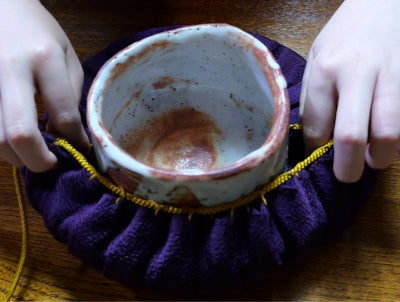
Picture a tea bowl that is not round. Its sides are pushed and pulled out of true, its rim rises and falls like a ridge, and its shape is closer to a worn shoe than a circle. Four hundred years ago this was scandalous — and entirely deliberate. This is Oribe, and the man whose name it bears broke the rules on purpose.
Rikyū’s disciple, the unruly master
Furuta Oribe (born Furuta Shigenari, 1544–1615) was a warrior, a daimyō, and a tea master. He served Oda Nobunaga and Toyotomi Hideyoshi, studied tea under Sen no Rikyū, and was counted among Rikyū’s seven leading disciples. After Rikyū’s death he became the foremost tea master in the land, and taught tea to the second Tokugawa shōgun, Hidetada; among his own students were Kobori Enshū and Hon’ami Kōetsu. Rikyū, it is said, urged Oribe to do what no one else would do — and Oribe lived that counsel more boldly than anyone.
Movement, against stillness
Where Rikyū prized quiet, simplicity, and the beauty of the withered, what Oribe brought to tea was movement. Bold colour — the vivid green that copper gives. Warped forms. A restless, undulating rim. And one difference is decisive: Rikyū cherished the irregularities the fire happened to leave, while Oribe went further and deformed the bowl with his own hands — pressing, pinching, and shaving the soft clay with a spatula to break the shape on purpose. The near-triangular kutsugata, the “clog-shaped” bowl, is the extreme of this; some were so distorted that even whisking tea in them was difficult.
Hachō — breaking the measure
This is not mere roughness. Hachō means deliberately breaking a settled harmony. To break a rule means something only where the rule is strict — and within the exacting discipline of tea, Oribe’s distortion was a daring declaration of freedom and of individuality. It is not carelessness: it is a man who knows the form completely, breaking it knowingly. That is what gives it movement, surprise, and a living face.

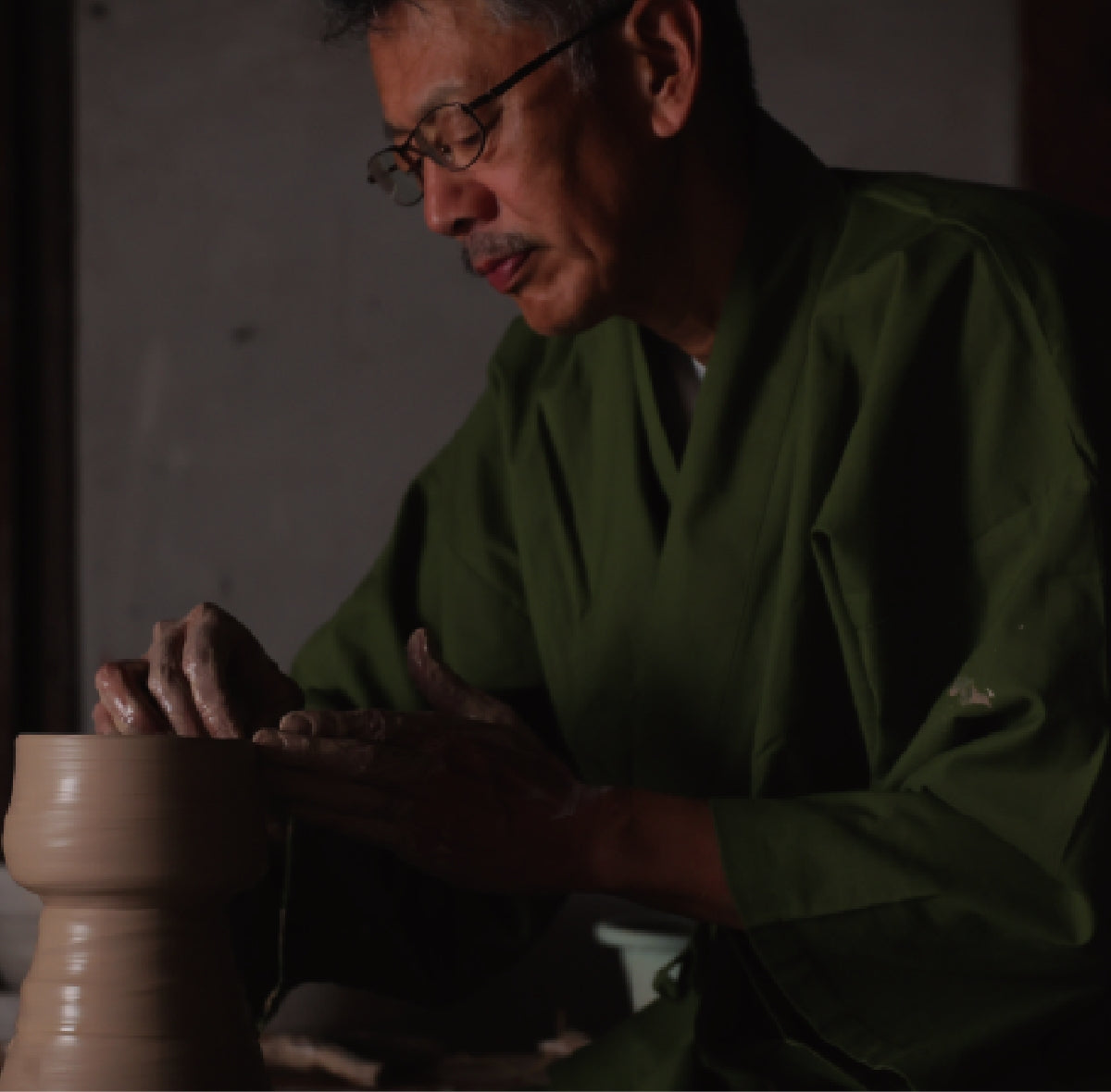
“To warp a bowl on purpose is the hardest thing of all,” says Kato Takaya. “To break a form, you must first have the power to make it true. A shape broken by someone who never mastered it is merely crooked. Oribe’s distortion has a spine — a sure technique underneath the breaking.”
Mino’s other fire
Oribe ware is a Mino ware, born of the same Gifu kilns as Shino and Seto-guro. Indeed Oribe-guro, the Oribe covered entirely in black, is fired by the very same “draw it out and quench it” method as Seto-guro, then given a distorted form. Shino, Seto-guro, Ki-Seto, Oribe — Momoyama Mino gave rise to these four siblings. It should be said that the link between Oribe the man and Oribe the ware is debated among scholars: Oribe was no potter but a warrior and tea master, closer to an arbiter of taste who guided the Mino kilns than a man at the wheel. Even so, that bold sensibility endures under his name. (The Metropolitan Museum of Art in New York has devoted an exhibition to him.)

“I fire Shino and Seto-guro, but there are times I notice that what I make is not only quiet,” Kato says. “When I try laying iron glaze over Shino, or let a form swing a little — at those moments, I think I am being gently nudged by what Oribe showed could be done, four hundred years ago, in this same Mino clay. Stillness and movement are not opposites. They are the two hands of one tradition. The more deeply you know the one, the more you can see the daring of the other.”
To make true, and to break
Oribe clashed in the end with the powers of his age, and in 1615 he was ordered to take his own life — offering not a word of defence. Yet the spirit of his breaking lives on in the bowls.

“To make a form true and to break it come from the same root,” Kato says in closing. “Knowing the form in your bones. I break a form too, when it calls for breaking. But I deeply honour those who, four hundred years ago, in the very midst of the rules of tea, had the courage to break it on purpose. The freedom we have in clay today is something such people widened at the risk of their lives.”
The Shino and Seto-guro of Kato Takaya can be seen at Gallery Son.