


- Type
- Setoguro
- Details
- A bowl for drinking matcha. On its front face it holds a green like garden moss paled by moonlight; turn it, and the rest is a jet black that throws back the light. Setoguro chawan.
- Materials
- Mogusa clay (rare clay)
- Size
- φ115mm
- Height
- 100 mm
- Weight
- 320g
- Texture
- The jet-black faces are glossy, with a smoothness that seems to cling to the hand. The moss face on the front has a quieter skin, and the two vertical ridges meet your fingers, so you know which way the front is as soon as you pick it up. Small and light, it sits in one hand. The foot ring is unglazed Mogusa clay, dry and slightly rough to the touch.
Features of this piece
A garden at night, with one patch of moss lit by the moon. The wide front face of this Setoguro chawan is a green like moss paled by moonlight. Down it run several black streaks, and two vertical ridges divide the face, so the streaks read as the shadows of trees fallen across the moss. The scene behind the name 夜苔, "Night Moss," gathers on this one face.
Turn the bowl and the moss slips out of view; what remains is a jet black that throws back the light. From both sides round to the back, the black is deep as lacquer, like the part of the garden the moon does not reach. Near the foot the black glaze swells and stops, and one drop hangs down to the edge of the foot ring. The rim is thin and gently uneven, and only the top edge of the moss face catches a pale, moonlit gleam.
Inside, the bowl is black throughout, and light pools in a small circle at the bottom. Whisk a bowl of usucha here and the green does not sink into the black; the moss outside seems to light up once more within. The tall, cylindrical form suits a winter tea gathering, and being small and light it sits in one hand, for practice as well. For the length of a single bowl of tea, a garden seen only at night rests in your hands.
Expected to ship within 10 business days from the date of order
Choose options
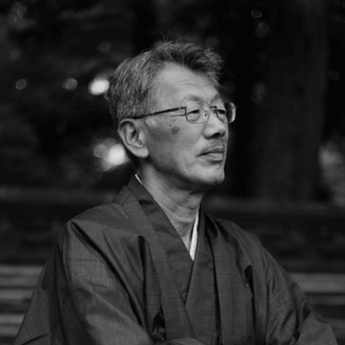
Setoguro

One from one kiln
Setoguro is renowned for its captivating, deep black color. Achieving this beautiful black involves using a glaze made from Oniita (iron-rich clay) mixed with ash. The piece is fired at high temperatures and then removed from the kiln while still hot, followed by rapid cooling—a technique known as "hikidashi-guro." This process was employed over 450 years ago and produced the elusive "Setoguro" ware for only about 30 years in the world of tea. In the tea ceremony, Setoguro is revered for its unique aesthetic value within the Japanese principles of wabi-sabi. By extracting the piece from a kiln over 1,100 degrees Celsius and cooling it quickly, the piece transforms into a deep black while producing beautiful cracking sounds (kan-nyu) as it cools. Only up to three pieces can be fired in one kiln at a time, and achieving a satisfying black is extremely challenging. It is said that getting one satisfactory piece from a single kiln firing is considered a success.

Rest for the heart - Setoguro
In a busy life, finding time just for yourself is harder than it seems. That is why a pause to stop and whisk a bowl of tea can quietly settle the heart. The black of Setoguro is a black that draws the light deep inside. Held in the hands, its depth seems to still even the noise around you. Whisked matcha turns a clear, vivid green against this black, leaving a little space to breathe, for the eyes and for the heart. The glossy black rests softly in the hand, and its gentleness at the lips loosens whatever has been held tight. A Setoguro chawan that Kato Takaya brought into being one bowl at a time. For a quiet moment, a little apart from the rush of the day.

Suitable for


Care
Please wash by hand using a soft sponge or cloth when cleaning. Please refrain from using abrasive sponges for cleaning.
Please note
